Qualio Quanteen
Source: Uncategorized • Published:
Qualio takes its hybrid thinking down to monitor size with the compact yet rather unconventional Qualio Quanteen. A small box with some decidedly big ideas behind it. That’s our subject this time around. Enjoy!
Wideband Teenie
Qualio is no stranger to these pages. I’ve had two of the Polish company’s speakers through here before, so this isn’t my first dance with the brand, nor is it my first attempt at figuring out what makes them tick. A while back I had a go at the exceptional Qualio IQ, followed later by its more compact sibling, the Quantum. Both were floorstanders, both came from the same rather peculiar corner of the Polish loudspeaker scene, and both left enough of an impression to make another Qualio-shaped box showing up at the door considerably more interesting than it might otherwise have been. Reason being, these products had a nice and very rare dipole twist to them. The arrival of today’s Quanteen was interesting for one additional, albeit very simple reason: this time around, we’re dealing with a monitor. The emergence of today’s effort alone would hardly qualify as breaking news. The audio industry has produced thousands of such products by now, so another compact two-way arriving on my doorstep would normally be greeted with about as much excitement as a fresh batch of printer paper. The Quanteen, however, was made by a company known for marching to its own beat and making proper waves on the loudspeaker scene. There’s also some history behind this design, and history tends to make otherwise ordinary-looking boxes rather more interesting.
The man who approached me about this particular review was Marek Kostrzyński, a name that should be familiar to anyone who has been paying attention to the Polish loudspeaker scene for more than five minutes. Along with Grzegorz Rulka, Marek was one of the people behind Cube Audio, and the two later went on to establish Qualio Audio. That partnership produced a number of interesting designs and, more importantly, put both men firmly on the map as serious loudspeaker makers. Their paths have since diverged. Grzegorz is now largely busy developing his own Virtual HiFi brand, while Marek remains involved with the development and management of both Cube Audio and Qualio. In this context, calling Marek merely “involved” with the products would be selling his contribution rather short. His design portfolio includes some well-known pieces of Polish loudspeaker history. He was largely responsible for the Cube Audio Monet, the Qualio IQ 30, and the Quantum, all three of them floorstanders. The Quanteen is the latest addition to that lineage, which makes it less of a random compact speaker exercise and more of a continuation of an ongoing design story. There is another part to Marek’s professional CV that makes the picture even more interesting. He has also worked on projects for Pylon Audio, one of Poland’s most known loudspeaker manufacturers and, importantly, a company that has spent years operating not only under its own name but also as an OEM manufacturer for various European speaker brands. In other words, Marek has had his hands in considerably more loudspeaker cabinets than the Qualio badge alone would suggest. I was told that his total contribution to the loudspeaker industry over the years now amounts to around 70 commercial efforts under different brands. That makes him an interesting character in a country that has quietly become something of a loudspeaker manufacturing powerhouse. Poland has a peculiar relationship with speaker production. Some local outfits build complete loudspeakers for other brands, often without the end customer ever having the faintest idea where the product actually came from. Then there are top-tier designers such as Marek, who move between those worlds and accumulate the sort of experience that doesn’t necessarily show up in a specification sheet.
And Marek’s career is particularly interesting because it has never been exclusively about putting another pair of speakers into another rectangular box and calling it a day. Cube Audio, after all, became known for purist, crossoverless wideband designs built around in-house-made full-range drivers, while Qualio subsequently explored considerably different configurations, combining dipole arrangements up top with conventionally vented enclosures below. The IQ and Quantum were not radically different loudspeaker concepts either; the latter was essentially the smaller, more compact expression of the former, retaining far more of the family DNA than its footprint or looks might suggest. The Quantum may have been easier to accommodate, but it was still dense, grounded and tone-rich, with the same dipole thinking up top that gave the larger design its particular character. That is perhaps the most interesting thing about revisiting Qualio. Having already spent time with the IQ and Quantum, there is now some context behind the name. I know where the company came from, I know roughly what Marek’s design language sounds like, and I know that the Quanteen isn’t arriving in isolation. It continues the brand’s philosophy, and its appearance in that roster makes a lot of sense. The Quanteen obviously is quite a different proposition from the two Qualios I reviewed previously. These were floorstanders, so their physical size was always part of the conversation. Today’s design is much more compact, and on paper it follows a much more familiar recipe: one mid/woofer, one tweeter, a passive crossover and a bass-reflex enclosure. If that description sounds suspiciously like the blueprint for most monitors currently occupying the world’s listening rooms, that’s because it is. Then again, specifications can be wonderfully deceptive things. Technically, this is a two-way monitor. In spirit, things are a little less conventional. That is also where the connection to Marek becomes useful. There is little point in discussing a loudspeaker designer’s background if the information doesn’t help explain the object sitting in front of you. In this case, it does. The Quanteen isn’t the byproduct of someone discovering a fashionable driver catalogue yesterday afternoon. It comes from a designer who has spent years working across different loudspeaker concepts. Considering who he is, we expect his designs to surprise us with something, no matter how small or inconspicuous they may be. On that note, let’s dive into how Marek decided to achieve just that with his latest Qualio effort.
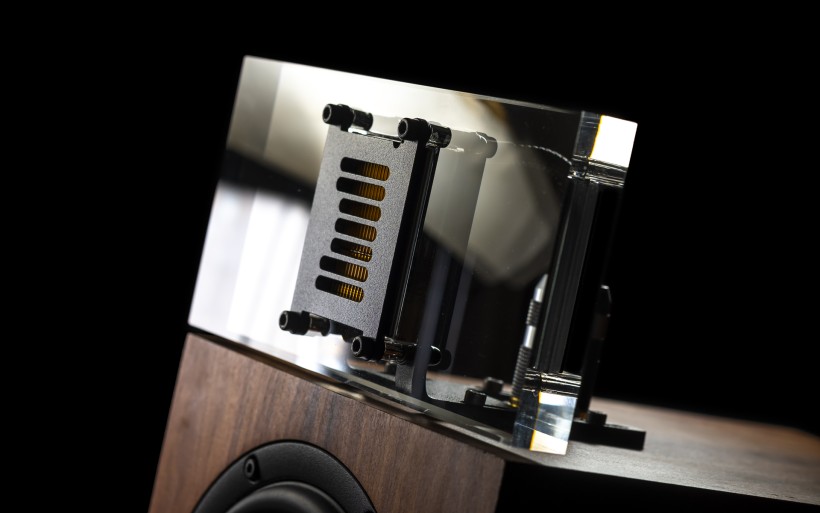
Marek delivered the Quanteen personally, which saved us the usual cardboard, foam, plastic and general wrestling match that accompanies the arrival of a pair of loudspeakers. This means that this time around there was no box to unpack, as I received two fully assembled specimens, already burned in and essentially ready to go. Given that this is a compact stand-mount monitor, this seemed entirely appropriate. Measuring (H x W x D) 48 x 20.2 x 29.5cm, the Quanteen is a fairly compact monitor by today’s standards, but at 17kg per speaker, it is also not exactly lightweight despite its proportions. The architecture is straightforward at first glance: a passive two-way with an MDF cabinet, conventional rectangular construction and a rear-firing bass-reflex port. Then the tweeter throws a small spanner into the works. It sits on a separate translucent baffle installed atop the main enclosure, and that arrangement lets it radiate from both sides as a dipole. Meanwhile, the six-inch mid/woofer remains inside the main box and deals with everything below the crossover point. This is the same broad architectural idea Qualio established with the IQ and Quantum, only reduced to a much smaller footprint. There is no attempt here to make the cabinet look like it escaped from an industrial-design exhibition. It is a box because a box works, and the interesting stuff happens elsewhere.
The driver complement consists of a six-inch SB Acoustics Satori dynamic mid/woofer and a Mundorf AMT tweeter. The former uses an ivory-coloured papyrus/cellulose cone and is the same basic six-inch Satori unit employed in the Qualio IQ, where the presence of a much larger 9½-inch woofer changes its job considerably. In the Quanteen, there is no dedicated bass driver to take the pressure off, so the Satori handles both low-end and midrange duties… and then some. That makes the choice of a relatively high crossover frequency rather interesting, because this little driver is being asked to cover a surprisingly broad stretch of the audible spectrum, much like a widebander would. The Mundorf AMT is the more unusual half of the equation, working as a dipole that propagates forward and backward. Its pleated, accordion-like membrane is the defining feature of an air-motion transformer, a technology associated with Oskar Heil and his original AMT patent, which expired in 2004. Compared with a conventional one-inch dome, the folded membrane provides a considerably larger effective radiating surface, with a much higher input-to-output ratio often cited as one of the technology’s characteristic advantages. In practical terms, this is the part of the Quanteen tasked with high-frequency bandwidth, but also with the perceived openness and speed, while its open mounting also makes the tweeter’s MO very different from the Satori below.
The bass section is handled by a rear-firing reflex port tuned to approximately 35Hz, matching the basic low-frequency target of the larger Quantum. For a six-inch monitor, that is a fairly serious ambition. The reflex loading allows the Satori to reach considerably lower than it could in a sealed cabinet of similar dimensions, with the usual price being a faster acoustic roll-off and greater group delay. Qualio also made the port pluggable, so the Quanteen can be converted to a semi-sealed enclosure when circumstances call for it. That can be useful with subwoofer integration or simply in a room where the additional output from the port isn’t welcome. Sensitivity of 86dB is hardly surprising for a compact monitor using a six-inch mid/woofer and a design brief that prioritises wide bandwidth over raw efficiency. There is only so much air a driver of this size can move, after all. The Quanteen therefore isn’t the sort of speaker I’d pair with an amplifier simply because its power rating happens to fit on a spreadsheet; it deserves something capable of controlling that little Satori properly. The crossover is where the Quanteen starts looking considerably less ordinary. It is still a conventional two-way electrically, but the handover happens at approximately 4kHz, with a third-order 18dB-per-octave slope applied to both drivers. The Satori is low-passed there, while the Mundorf AMT is high-passed at the same frequency. Compared with the roughly 2–3kHz crossover point common to most two-way monitors, 4kHz is decidedly high. The rationale is straightforward enough: keep the Satori working over as much of its natural range as possible, while handing the upper registers to the AMT above the realm where our ears are most sensitive. Phase matching also played a role in arriving at this particular topology.
In his own Quanteen review, which ultimately earned the speaker an award, Srajan Ebaen pointed out a certain musical logic behind the unusually high 4kHz crossover. C8 sits at 4,168Hz, while the highest fundamental of a violin, A7, is around 3,520Hz. The crossover therefore arrives after most of the fundamental information from many acoustic instruments has already been handled by the Satori, leaving the AMT to take over much of the higher harmonic material. That is quite different from dropping the crossover into the presence region, where both drivers would be sharing some of the most sensitive territory. With the Satori covering such a wide range and the crossover pushed this high, the Quanteen ends up behaving somewhat like a wideband design despite remaining a perfectly ordinary two-way on paper and, to an extent, on looks too. In practice, while the electrical topology remains two-way, full stop, the Quanteen’s behaviour is something else entirely. More about that in a bit. The above also explains why keeping the passive network under control matters here. Every crossover component is another opportunity for energy storage, loss and phase shift, so allowing the Satori to cover a broad range before handing over to the AMT avoids placing a large amount of filtering in the most sensitive part of the midrange. Qualio doesn’t appear to have a one-size-fits-all crossover recipe either; component values and slopes are selected around the drivers used and their intended behaviour in each particular design. In the Quanteen, that philosophy results in a relatively simple-looking network whose unusual feature isn’t an exotic topology but where the crossover point is actually placed.
Cabinet construction is refreshingly uncomplicated. The main enclosure is MDF, rectangular and rear-ported, with the AMT sitting separately on its acrylic baffle. Compared with the larger IQ, there is considerably less cabinet surface around the drivers, which makes the Quanteen physically easier to accommodate as well as visually less imposing. Qualio offers a dedicated stand, although there is nothing preventing the speaker from being placed on suitably solid furniture. It isn’t the sort of monitor I’d casually mistake for a tiny desktop speaker, but it remains considerably easier to live with than the larger Qualio designs I’ve had here before, which is precisely what this project set out to achieve. Connections follow the same no-nonsense philosophy. The Quanteen uses WBT speaker terminals and is single-wired, so bi-wiring/amping activities are off the menu. The AMT has its own connection, with its lead terminating in a Viborg XLR3 plug. The cable is sleeved and cut to the necessary length, only as long as it really has to be. In practice, it doesn’t dangle around the rear of the speaker. There isn’t much else to discuss here, which is probably a good thing. The Quanteen’s unusual decisions have been spent where they actually affect how the speaker works rather than on filling its rear panel with options.
As for appearance, Qualio offers the Quanteen in a selection of painted and veneered finishes, including matte, gloss and custom options. My pair arrived in satin natural veneer, which puts the price at €5,600 per pair; depending on finish, the range runs from €5,200 to €6,200. At this money, the Quanteen enters a busy field of rather costly compact two-way monitors, but its recipe is anything but generic. A six-inch Satori covering a broad range, a Mundorf AMT working as a dipole, and a 4kHz third-order crossover make for a fairly specific set of engineering choices. While the cabinet may be modest in size and deliberately uncomplicated in construction, there is considerably more going on here than the familiar “six-inch woofer plus tweeter” formula initially suggests. Now it’s time to spill the beans on how the Quanteen performs. As per usual with any speaker, getting the setup and positioning right was the first order of business. The Quanteen had to fight my reference sound|kaos Vox monitors, and it had to do so in exactly the same system, comprising the LampizatOr Horizon360 DAC, Innuos Statement Next-Gen server/streamer and Trilogy 915R/995R analogue end. Being a monitor, the Quanteen also called for proper stands, and here I reached for my trusty Soundstyle Z1 pillars. To give the little Qualio some additional support in the context of its considerably pricier opponent, each speaker sat on three LessLoss GiantSteps footers, while the Z1s themselves rested on sound|kaos Vibra60 wire-suspension pucks.
As for positioning, I initially treated the Quanteen like any conventional speaker, placing it roughly a metre from the front wall and around 70cm from the side walls, with a gentle toe-in. After some experimenting, however, I found that moving the speakers another 40cm into the room, towards the listening seat, produced better results as far as spatial depth and layering were concerned. The Quanteens were still nowhere near as close to the listening seat as my Vox monitors normally are, but the distance was shorter than I would typically use with a monitor and also more intimate than with the recently reviewed Lu Kang Spoey 200GD. With all that sorted, the game was afoot. To judge a book by its cover, one could rightfully think that, despite its dipole twist, the Quanteen is a regular two-way affair. The more I looked at it and, more importantly, the more I listened to it, the more apparent it became that this speaker isn’t particularly interested in following the established monitor playbook. Loudspeakers are ultimately exercises in compromise. Every driver has limits, every crossover introduces its own set of problems, every enclosure changes what the drivers are asked to do, and every attempt to gain something in one area tends to cost something somewhere else. The clever part is deciding which compromises are acceptable and which ones are worth avoiding altogether. With the Quanteen, it became very apparent what kind of core assets Marek chose to prioritise: immediacy, timing, spatial intensity, articulation, lucidity, and that particular quickening that creates the sensation of music being present here and now. In my book, that was just the territory I’m well accustomed to.
In that sense, listening to the Quanteen was a remarkably veil-free experience. There was no blur, dimness or anything getting in the way of seeing—or rather hearing—what was actually happening. The view was properly sunny, finely organised, busy with a generous amount of detail, and all things considered, the sound coming from this monitor had a lot in common with the purist full-range speaker breed. More than anything else, actually, it sounded like one, just disguised as a compact two-way. Now, wideband drivers are rarely about gargantuan amounts of fat and warmth. They tend to trade some of that for speed, coherence, directness and finesse. What they can deliver in spades, however, is heroic imaging in every sense of the description, and that’s exactly what the Quanteen did remarkably well. To elaborate on the imaging front, the way the Quanteens project aural landscapes is remarkably close to what my Vox monitors do. I’m not talking merely about the usual audiophile dimensions of width, height and depth, but about the way those three combine into something considerably more immersive. The stage doesn’t feel like a picture hanging on the wall in front of us. It has volume, air and presence, with images extending around the listening position to an extent and creating the impression that we’re sitting inside the acoustic event rather than observing it from a safe distance. That distinction is important, because this sort of spatial behaviour does something rather useful to perceived immediacy. When instruments occupy clearly defined positions within a sufficiently open and enveloping field, the usual barrier between listener and recording becomes thinner.
The Vox monitors take this idea even further, partly because I use them considerably closer to the listening seat and partly because their Raal ribbons are almost absurdly good at exposing the finest spatial information. With those speakers, I’m often presented with the sensation that there is nothing between me and the recording, right down to what feels like the tiniest dust particles floating around individual instruments. The Quanteens don’t quite reach that level—and I wouldn’t expect them to—but the family resemblance was unmistakable. Their presentation was almost as enveloping, almost as immediate and, importantly, just as alive. This was particularly impressive considering that the Quanteens were sitting farther away from me than the Vox monitors normally do. The Mundorf AMTs deserve much of the credit here. Their ability to retrieve fine information was obvious, but it wasn’t simply a matter of throwing more detail at the listener. The upper registers had proper substance, decay and air around them, allowing cymbals, strings, room reflections and other small-scale information to linger naturally rather than being reduced to bright outlines. There was plenty to see into, but nothing felt artificially illuminated. This is an important distinction. A speaker can expose detail by simply pushing the treble forward, but that wasn’t what happened here. The Quanteen instead made the acoustic space itself unusually legible, which is why its imaging came across as immersive rather than merely spectacular. The result was the sort of well-illuminated and energized presentation I’m very much accustomed to and, as a biased enthusiast like anyone else, one I personally thoroughly enjoy.
Considering all of the above, the Quanteen was already a very accomplished speaker in my book. Srajan made a similar observation, describing it as behaving more like a one-and-a-half-way design than a conventional two-way, and I can see exactly where he was coming from. It sounds like a widebander, simple as that. It releases a similar sort of energy into the room, brings ambience forward in much the same way and has that particular sense of coherence, intelligibility and spatial continuity I associate with good full-range designs. It gets remarkably close to the sort of presentation pulled by the best widebanders I know. The fascinating part, of course, is that it isn’t one. That’s the gotcha at the heart of this project, and arguably its most interesting twist. Then again, perhaps we shouldn’t be too surprised, considering that Cube Audio exists and is Marek’s other child, no less. Which naturally raises the next question: if the Quanteen manages to behave so much like a widebander through the midrange and up, what happens down below? This is where its more conventional monitor architecture makes itself known. The little Satori, despite doing a lordly amount of work, isn’t going to dig into the bottom octave or deliver the sort of physical slam a much larger dipole can muster. There are limits to what a six-inch driver in a compact, regularly vented cabinet can accomplish, and pretending otherwise would be silly. My Vox monitors, with their twin five-inch woofers, are somewhat more capable in this department. The Quanteen doesn’t try to win that particular contest either, and I fully appreciate it for what it already does, and how it goes about doing it.
In fact, the way the Quanteen handles bass makes considerable sense once its placement as described is taken into account. Used in the midfield, so with generous distance between the rear-firing ports and the front wall, the speaker has room to breathe and the amount of unwanted interaction around the port is easier to keep under control. Marek clearly didn’t appear tempted to squeeze some ridiculous amount of bass out of the enclosure simply to demonstrate how far a small monitor can be pushed. He’s too versed as a speaker maker to pursue such stunts. The Quanteen’s low end is there to support the rest of the presentation rather than steal the show. It gives the music sufficient foundation, weight and scale, but doesn’t constantly remind us that a six-inch driver is being asked to perform miracles. And that’s probably the most sensible way to understand the whole design. The Quanteen sounds like a widebander with a very potent dipole twist, while its bass section behaves more like that of a conventional compact monitor. The former is the star of the show; the latter is there to make sure the star has a proper stage to perform on. Bass doesn’t dominate the presentation, nor does it need to. It complements everything happening above it, allowing the Quanteen’s real party trick—its remarkably open, direct and spatially intense midrange and treble—to remain the focal point. For this particular speaker, that balance makes considerably more sense than chasing additional bass output at the likely cost of diluting the wideband magic that makes the Quanteen what it is, or perhaps removing it from the equation altogether.
Should potential buyers interested in the Quanteen feel that these speakers are shy on bass? To me, they aren’t, but each to his own. Those who want more can simply plug the ports, add a subwoofer and have the best of both worlds: a widebander in disguise doing its thing up top, with a dedicated bass solution that goes to places the Quanteen cannot on its own. How to go about that properly? Well, Srajan has practically written a book on the subject through his reviews, given how often he explains the protocol and the equipment required to make such arrangements work. His speaker reviews contain plenty of material on the matter, so I’ll leave that particular rabbit hole to him. I won’t be going down that route here. I simply don’t have a subwoofer and an active standalone high/low-pass crossover at hand to review the Quanteen as part of a more elaborate multi-box system along the lines Srajan uses, and most people considering this speaker won’t either. The Quanteen was therefore judged on its own, because that’s how most owners will experience it. And for what it’s worth, I got considerably more from it than I initially assumed. I went into this review expecting a fairly conventional compact monitor with a nifty dipole trick bolted onto the top, partly to tap into the familiar Qualio aesthetic, both visually and sonically. What I got instead was a brilliantly voiced speaker that, in many respects, behaved like a purist full-range design. Topologically, however, it had absolutely no business sounding like one.
That makes the Quanteen particularly interesting to anyone who already appreciates what speakers such as my sound|kaos Vox monitors can do, but doesn’t necessarily want to spend that kind of money to get into the same general territory. The Quanteen obviously isn’t a cheaper Vox, nor does it pretend to be. It takes a different route, has different strengths and gives up some things along the way. Yet it gets surprisingly close to that particular combination of immediacy, spatial involvement, coherence, clarity, and wideband-like energy that I value so highly. Considering that it sells for considerably less than my reference speakers, that’s no small achievement. And unlike a crossoverless full-ranger, it doesn’t demand esoteric low-output-Ω amplifier to sing. Quite the contrary: the Quanteen enjoys power and control, making amplifier matching considerably less fussy than its wideband-like sonics might suggest.
And I think this is ultimately all you need to know. The Quanteen is an ace performer not because it somehow cheats the laws of physics, but because Marek was very selective about which compromises to accept and which traits to prioritise and elevate. That’s key. Lest we forget, his full-range roots run deep, and they clearly inform what this speaker has become. The wideband magic is there, the dipole element serves it beautifully, and the bass knows its place, providing a solid foundation without competing for attention or pulling stunts beyond its frame. The Quanteen is a compelling, classy little design that chooses its strengths carefully, plays to them relentlessly, and makes an unusually convincing case for its particular way of doing things. That’s exactly what makes it a true standout in the crowded monitor field—and one hell of a Qualio.
Associated equipment:
- Amplifiers: Trilogy 995R, FirstWatt F7, Enleum AMP-23R
- DAC: LampizatOr Horizon360 (Stradi 5U4G + Psvane Summit 4x KT88 / 2x 6SN7)
- Loudspeakers: Boenicke Audio W11 SE+, sound|kaos Vox 3afw
- Transport: Innuos Statement Next-Gen, fidata HFAS1-S10U (on standby)
- Preamplifiers: Trilogy 915R, Thöress DFP
- Speaker cables: Boenicke Audio S3, LessLoss C-MARC
- Headphones: HIFIMAN Susvara Unveiled, Campfire Audio Cascade, Vision Ears VE5
- Loudspeaker signal conditioners: LessLoss Firewall for Loudspeakers, Boenicke ComDev
- Vibration-control accessories: 6x Carbide Base Diamond (under the streamer), 6x Carbide Base Micro Diamond with TwinDamp inserts and spikes (under the DAC and preamplifier), Stack Audio Auva 70 (under the loudspeakers), 12x LessLoss Giant Steps (under the streamer, DAC, and preamplifier), sound|kaos Vibra 68/30 (on standby), Virtual HiFi Vibron M/L/XL (on standby), Stack Audio Auva EQ (on standby)
- Interconnects: LessLoss Entropic Process C-MARC, Boenicke Audio IC3 CG
- Power: Gigawatt PC-3 SE EVO+/LC-3 EVO, LessLoss C-MARC, LessLoss Entropic C-MARC, LessLoss Stellar C-MARC, LessLoss Power Distributor -> Boenicke Audio Power Gate, ISOL-8 Prometheus, LessLoss Firewall 640x Stellar
- USB cable: AudioPhonique Desire USB
- Equipment rack: Franc Audio Accessories Wood Block Rack 1+3
- Network: Fidelizer EtherStream, Linksys WRT160N
- Music: NativeDSD
Retail prices of reviewed components in EU (incl. VAT):
- Qualio Quanteen (satin black/white): €5’200/pr
- Special color/natural veneer: +€180/400
- Gloss finish: +€300