DL Custom Audio GR AC CONNECT MK2
Source: Uncategorized • Published:
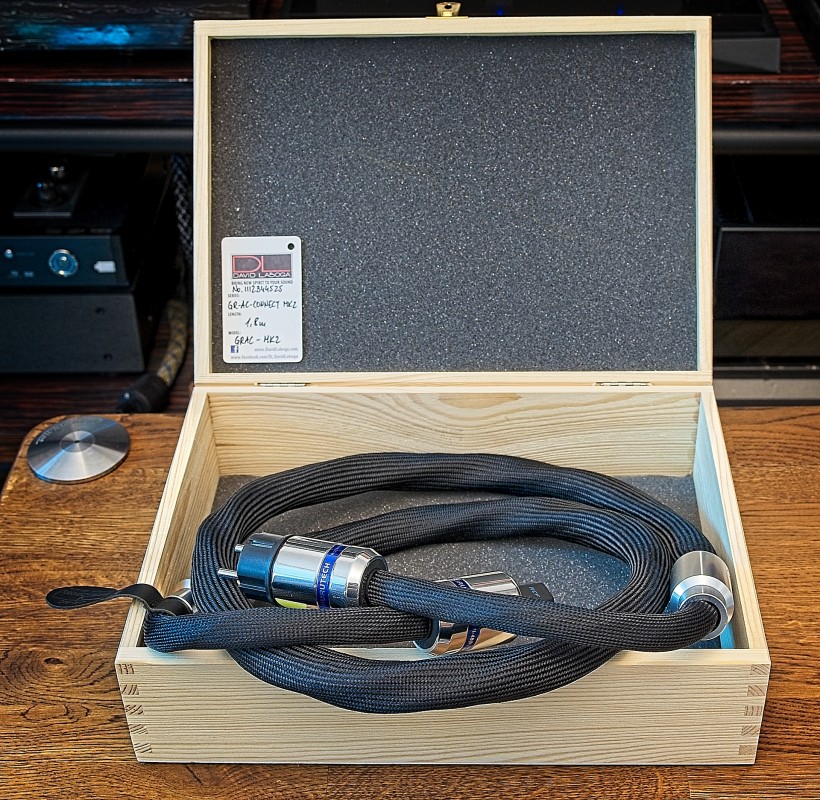
As a happy user of the DL Custom Audio 3DR-S-AC power cable from the manufacturer’s top line, I welcomed the opportunity to review a less expensive, but according to the designer, (almost) equally impressive David Laboga Custom Audio GR AC CONNECT MK2. The „R” in the name suggests rhodium-plated connectors, and MK2 reveals that it is the second, latest version of this model. Let’s get to it.
Introduction
You can find several reviews of David Laboga Custom Audio cables on the HiFiKnights website. In most of them I assessed digital cables – USB (you can check them out HERE, HERE, and HERE) and Ethernet (HERE) ones in particular. In fact, I found them so good in performance and in meeting what I personally require from cables to fully enjoy the sound that I decided to include both in my reference system. One is the current top USB cable, Akoya, which replaced the previously used Emerald (the cheapest but still an exceptional performer).
The other that is part of my reference setup is the Sapphire LAN cable, or actually two of those. Until recently, it was the mid-range model (among the three available at the time) that I started to use along with Emerald USB. One connects the switch to a wall socket, and the other connects the switch to my custom audio file server. Let me add that the very latest, premiered at the Vienna 2026 High End Show, Akoya LAN cable’s review is in the works as well – that’s the fourth Ethernet cable by David Laboga. Since we are not in the movie industry, I can let a tiny little spoiler slip – it is good, damn good! While most of my reviews covered digital cables, I did also test top analog and power cables by David Laboga, from the DL Custom Audio 3D and 3DR series, as well as the DL Custom Audio 3DR Two in One Connect MK2 speaker cables (see HERE, HERE, and HERE). All of those belonged to the top-tier performers, and, it may be even less objective, but it is my honest opinion, might be the most elegant, most beautiful-looking cables I’ve ever dealt with due to their gorgeous leather jackets.
When we met in Vienna, I asked David Laboga for a test unit of the Akoya LAN cable. He obliged, but additionally, he also offered a new iteration of one of his power cables, namely the David Laboga Custom Audio GR AC CONNECT MK2. I did not have a chance to listen to the original, so I won’t be able to offer you a comparison between the two. Still, after all the experiences with David’s cables, I had absolutely no reason to refuse the offer. He actually sent the cables already to Berlin, where I reviewed the latest, phenomenal SoundSpace Systems Rossignol loudspeakers, and we used them in the setup for the review (see HERE). Later, both cables were sent to my place, and I decided to assess the power cable first. So let’s dive in.
Design & Features
As already mentioned, I did not have a chance to test the original version of this model, but judging by some photos from other reviews, I can say that you can differentiate them easily, as the original used a sort of striped jacket, while the MK2 version features a solid black one. As is usual for the brand, information on the design is scarce. The cable is quite thick yet flexible. The standard length is 1,8 m, and the cable is delivered in a nice wooden box padded with some foam for the cable’s protection. What little David shared with me was that he used copper conductors, including the so-called red copper of various types and thicknesses.
The cable, as it comes from the 4th (out of 5) level, is terminated with Furutech’s top-quality plugs using NFC technology, namely FI-E48(R) on one end, and FI-48(R) on the other. Along the length, some 20 cm from each plug, you will find custom aluminum splitters screwed onto the cable, as well as leather tags with the brand’s logo. For those unfamiliar with the Furutech plugs and NFC technology, both considered to be among the best, if not THE BEST, in the audio world, let me offer some basic information on them.
The Furutech FI-48(R) NCF is a high-end audiophile-grade IEC C15 power connector, and the FI-E48(R) is a Schuko plug. For both, all conductive parts are made of non-magnetic materials (OCC copper) coated with a layer of rhodium using a new technique (for increased durability) and subjected to the Alpha process (demagnetization and cryogenic treatment). The Piezo Ceramic series connectors incorporate nanotechnology, carbon, nylon, and polycarbonate inserts to dampen vibrations, while the body, made of non-magnetic stainless steel, prevents the housing’s resonance. The bespoke material the manufacturer used in these plugs is called Nano Crystal²-Nano Crystalline. It consists of carbon powder and NCF ceramic nanoparticles.
As already mentioned, „R” in the name of the cable stands for „Rhodium-plated”. Some of you may remember that the manufacturer offered two basic versions of the top power cable, one with rhodium-plated plugs, and the other with gold-plated plugs. It is also the case with the David Laboga Custom Audio GR AC CONNECT MK2 (the „gold” one skips the letter „R” in the name). In the top line, you could order a custom version of your cable, meaning with gold on one end and rhodium on the other. Let me add that, while the look of the top line with leather jackets is unmatched, the simpler, yet also elegant finish of the tested cable with a black fabric jacket should easily satisfy most users.
Sound Quality
Since my main reference amplifier is the GrandiNote Shinai integrated, which requires two power cables, and I had only one GR AC CONNECT MK2 at my disposal, most of the test was based on how it worked with my reference D/A converter, LampizatOr Poseidon 2. Later, I paired it also with other fantastic DACs, namely Playback Design MPD-8 and Destination Audio ECC40 Tube DAC. Last but not least, in the final stage of the assessment, it powered my other amp, Circle Labs M200.
Daily, this function (power cable for the reference D/A converter) is performed by another product by David Laboga Custom Audio, namely DL Custom Audio 3DR-S-AC. It belongs to the top series; the „R” suggests rhodium-plated plugs, and the „S” indicates it is a „lighter” (thinner) version intended for source components. I’d been using it for quite some time, and I was sure I knew its sound well enough to point out differences between the two power cables easily. As it turned out, when I finally started to compare them, it wasn’t quite so simple.
Why? Because they turned out not to be so different after all, at least in terms of the level of performance. While comparing the top product with one sitting lower in the lineup, one may expect a significant advantage of the former. It was not the case simply because such expectations work pretty well when it comes to entry- and mid-level audio products but start to fail when you enter the high-end level. Then the differences shrink significantly, as the more expensive products offer a much smaller reward compared to the price increase. They still do perform better, to be clear, but the improvement is not as significant anymore.
That is why I needed quite some time and going back and forth between both models to establish that there were some differences in most scenarios favoring the top one, and then to try and define them for you. The good news is that the GR AC CONNECT MK2 is yet another excellent performer by David Laboga Custom Audio and at a lower price. So how much and in which areas do we „lose” if we decide to save some coin? I’ll try to explain and make it easier for you to make your choice.
First of all, surprisingly, and unlike all the other differences that I had to dig deep for, one obvious difference from the very beginning was the impression that with the tested power cable the volume of the sound was a touch higher. The difference wasn’t big enough for me to compensate for it using Shinai’s volume control, as one step was already too much. Still, with the tested cable, the sound was a little bit louder.
Louder sound is always more impressive: there is no escaping that. It seems more dynamic, more present, more energetic, which is why it is important to compensate for the differences between any compared audio components. Since I could not really do it with volume control (at least not in the integrated – the one in Poseidon did the job, but it meant activating it instead of bypassing it, which would mean using two volume control circuits, which is never a good idea, so I decided not to use it), I had to „compensate” for it in my head.
Once I did, it soon became clear that the tested model could challenge the top one in terms of dynamics, and it also seemed a little bit more energetic. What it actually was about was sort of the directness of the presentation as compared with a slightly more laid-back one of the more expensive model. After longer sessions, it became clear to me that 3DR-S-AC saturated presentation with even more energy, but it was more equally distributed throughout the whole frequency range; hence it wasn’t as impressive at first, but ultimately it came back on top in this comparison. Therefore, it was GR AC CONNECT MK2 that made a bigger impression short-term, but in the long run, it was still 3DR-S-AC that did a slightly better job in this regard (with a small caveat I will mention later).
The second difference that took me longer to notice was a „thicker”, more „golden” presentation of treble by GR AC CONNECT MK2, as was best showcased with cymbals and other metal percussion instruments. I wasn’t ready to call any of those two excellent cables particularly sparky or snappy, yet when listening to music there was nothing missing from it even if such instruments were played pretty hard. On the other hand, I was delighted with how resolving the tested power cable was, even if it was clear that the top one was still a half step ahead.
In both cases, the high tones seemed richer and smoother than all the other power cables that I used in my setup, despite featuring the „R” plugs. These qualities are commonly associated with „G” plugs, not the „R” ones, but David Laboga Custom Audio cables, while differing slightly depending on the plugs, even with the rhodium-plated ones, sound richer and sweeter than most. Since both power cables featured the same type of plugs, the comparison was fair and proved a slight advantage of the more expensive model, and yet also an outstanding performance of the tested one, which again came really close.
Interestingly, though, despite sounding slightly „thicker” or „heavier” with GR AC CONNECT MK2, the metal instruments still had a lot of „zing” to them, as there was a lot of energy in the drumsticks hitting them and in their response. Maybe not quite as much as with the top cable, and maybe the decay phase was a touch shorter, but it was barely noticeable. I could easily imagine that in some systems, particularly those with slightly (!) brighter upper range, or simply to better suit someone’s individual taste, the tested cable could be the preferred choice as it turned the treble a tiny little bit sweeter or more mellow. Therefore, if you find the upper treble/midrange in your setup a little too bright or too harsh (I mean a subtle discomfort, not a serious issue), GR AC CONNECT MK2 might be a preferred choice over the top cable, as the latter could expose such features a little more. It seemed to me that the latter would be a better fit for already perfectly balanced setups to enhance their qualities, not to amend their weaknesses.
Moving on. After another extended listening session, I concluded that with the 3DR-S-AC, the Poseidon 2 seemed to deliver a slightly more transparent and more resolving presentation. There was a little bit more information on the texture and tone of instruments and vocals, and a touch better differentiation in terms of both dynamics and tone. These features resulted in an even more complete, more realistic, and more natural presentation of music. The upper hand in resolution became more easily noticeable with high-quality recordings, for example, when drummers moved from sticks to brushes, as it was more difficult to convey intricate details of their performance using the slightly (!) less resolving model.
This particular advantage of the top cable extended to the other parts of the range as well. Whenever the recording conveyed enough tonal and dynamic micro-contrasts, it was clear that while GR AC CONNECT MK2 did an excellent job, better than any other power cable I owned, and most of those I had reviewed, and yet 3DR-S-AC still did it even slightly better. The difference, though, wasn’t particularly big. It was, in fact, almost negligible. It is possible that in slightly less resolving systems it could be completely irrelevant.
Another observation that actually brought me back to the initial one was that the center of gravity of the presentation seemed to be set a bit lower with the GR AC CONNECT MK2. What it actually was about was a slight boost placed in the lower midrange/upper bass range, extending even to the mid-bass. This whole part of the range seemed (a little bit) richer or thicker, and more forward, which made it stand out a bit more and attract more attention. It added authority to the vocals and many, if not most, instruments, thus seemingly lowering the center of gravity of the whole presentation. It translated into a more present sound, and the entire presentation seemed to be placed a bit closer to me. And that was a really pleasant way of presenting the music – close, palpable, rich, yet still open, and vibrant.
The 3DR-S-AC, on the other hand, extended the bass a bit lower, resulting in performance that had even more authority, especially when it came to „large” music (operas, symphonies, rock, and so on). It also distributed mass and saturation more evenly across the whole range. It offered a deeper, more three-dimensional perspective, with better-defined individual sound sources. The foreground was placed a bit farther away from me, yet the individual phantom images were at least as palpable and three-dimensional as with the tested cable, but better spaced and separated from each other. It was because the palpability, or presence, of the instruments was built by using more precise contours, while the GR AC CONNECT MK2 achieved a similar effect by giving those sources a bit more weight, filling them in more, while the contours were not quite as clearly outlined.
So when I listened to Muddy Waters’ „Live at the Checkerboard Lounge” album, the top cable gave me a little clearer and more detailed insight into the performance of each guitar player even when they all crowded at the small stage rubbing elbows. The tested cable, while not quite on par with the top model, still did an excellent job in this regard, outperforming many other cables I knew. On the other hand, whenever the vocals became the centerpiece of the performance, whether Muddy’s or Mick Jagger’s (or combined), the tested cable brought them out of the crowd a little more, made them even more present, more expressive, and more here and now.
Which approach to music presentation was better? That’s the question you have to answer yourself because, while I keep mentioning the advantages of the top cable, it is only to show you that if you can afford it, you should go for it, and not to prove that the GR AC CONNECT MK2 is not worth your attention. This is a remarkable product that comes really close to its more expensive sibling in terms of performance and class, and without a direct comparison you won’t even know that you’re losing a tiny little bit of quality. In some cases, you may choose the bigger, closer presence of the performers over a little bit better separation and resolution achieved with the top cable.
Since I didn’t want to base the whole review on the (no matter how good) combined performance of the DL Custom Audio GR AC CONNECT MK2 and LampizatOr Poseidon 2, I did give it a try paired with some other excellent components. The first one was Thoeress Phono Enhancer MK III (phono stage), and then came Playback Design MPT-8 Transport (CD/SACD and audio file/streamer), Destination Audio ECC40 Tube DAC, and last but not least my other reference power amplifier, Circle Labs M200. It wasn’t about comparing the tested model to the top-of-the-line one anymore, but rather about its performance when paired with other types of top-performing audio devices.
The latest Thoeress phono stage (I should say: the latest version of) actually came first. The main source in this scenario was my trusted J.Sikora Standard Max with KV9 tonearm and LeSon LS 10 MKII MC cartridge. The rest of the setup was the same as before. As I did the review of the German device for another magazine, let me share only briefly that, in my opinion, its performance, while exquisite (and it offers an insanely good price/performance ratio too!), maybe even better than its predecessors’, differed from them, at least as I remembered it. The previous iterations, the same as Reihard’s other tube-based creations, seemed not only very natural sounding, which is what good devices featuring tubes usually have to offer, but they combined it with very neutral tonal balance, accuracy in terms of conveying whatever was recorded, plus outstanding clarity and transparency. As a result, I always called them natural and neutral-sounding top performers and loved what they had to offer even if they were not typical tube components.
The latest phono stage slightly moved the (temperature) scales towards the natural side of things, so to speak. It seemed to me that it sounded a touch warmer and richer than the predecessor. It preserved its remarkable ability to resolve myriads of details, and perfectly conveyed all the tonal and dynamic contrasts, also those on the micro level. It still (at least) matched the impressive clarity and transparency of the predecessor, and it followed in its footsteps in terms of coherence and fluidity, adding a little more richness and saturation.
Now, let’s finally get to what DL Custom Audio GR AC CONNECT MK2 power cable did for this brilliant phono stage. Let me add that during my test of this phono stage, I powered it using my trusted LessLoss cable. Everything that I’ve mentioned above about the phono stage was still true when I paired it with David’s product. So what changed? Remember, when I said that the tested cable, while sounding richer, particularly in the treble range, still delivered it with the necessary „zing”? These features (richness of tone and „zing”) further enhanced the more tube-like sound of the Phono Enhancer. With it, the phono stage sounded even smoother, and yet, when needed, it still delivered the midrange (say, electric guitars) with a proper bite, and the sound of cymbals and other metal percussion instruments with a very nice zing. In fact, the Polish power cable seemed to better preserve the energy of the performance, which is one of the key features if the sound is supposed to be very live-like, which I love.
Furthermore, this aforementioned gentle emphasis in the lower midrange/upper/mid-bass region added even more presence to the presentation. Instruments became slightly bigger and more palpable, especially those in the foreground (those in the back too, but to a smaller extent). The David Laboga Custom Audio’s cable also proved how good it was at resolving tiny details of every well-recorded performance, and how good an insight into whatever information had been stored in the groove it offered. On top of all of that, GR AC CONNECT MK2 added a little more air to the sound, opening it up a touch more compared to LessLoss. All in all, this was a very good marriage between the Polish cable and the German phono stage. These two beautifully complemented each other and together offered more than a simple sum of their qualities.
When paired with Playback Design MPT-8 Transport, a device from the top Dream line of this American manufacturer, GR AC CONNECT MK2 once more proved its remarkable class. In my test (coming soon), this CD/SACD and audio file transport turned out to be one of the very best I knew. It is quite costly at 23.990 EUR (+ 3.590 EUR for a built-in optional streamer that was installed in the reviewed unit), but it is worth every penny. In fact, I reviewed it together with the Playback Design top DAC, the MPD-8, and I had to choose which David Laboga Custom Audio power cable should power which unit. Finally, I went with the top one for the DAC, and the tested one for the transport, so in fact it was more of a combined performance of these two rather than only of the tested one.
Still, there was no doubt that GR AC CONNECT MK2 powering MPT-8 did an outstanding job. It proved to be more resolving and more revealing than my LessLoss, and yet served the music with a better, smoother flow. The clarity and transparency of the presentation were exceptional, yet the richness of the whole range, the ability to resolve the tiny details, and tonal and dynamic contrasts, and yet ultimately presenting a super-coherent, complete whole, was stunning. On top of that, the presentation had that incredibly smooth, almost creamy quality to it, and I loved it!
When paired with the Destination Audio ECC40 Tube DAC (another review coming soon), the Polish power cable seemed to fit it (almost) perfectly, revealing its high potential when it came to conveying all the spatial aspects of the recordings. It was not just about the size (particularly depth) of the soundstage, and how big and palpable or how well spaced the phantom images were on it. It was also about realistic reverbs in live recordings, whether in large or small venues, about long sustain and decay paired with fast attack that made every instrument sound accurate and quite „here and now”.
It was also about conveying it all in a vivid, energetic way, thus making the presentation even more live-like, which, again, is a quality I crave in every audio component, as live music is my ultimate reference. Long story short, paired with the (spoiler alert!) stunning Polish D/A Converter by Wlodek „Sam” Wisniewski, David Laboga Custom Audio GR AC CONNECT MK2 power cable proved its class once more. Not for a second did it feel like it was a bottleneck limiting Destination Audio’s fantastic performance. If I were to own this excellent device, I would seriously consider powering it using the tested cable, as together they delivered not only top performance, but their sonic character perfectly satisfied my personal expectations, which doesn’t happen that often.
Last but not least, I paired GR AC CONNECT MK2 with my Circle Labs M200 stereo power amplifier. That was a combination that I can honestly declare better (for me!) than the same amp powered using the top 3DR-S-AC. Mind you, though, that this version of the top-of-the-line power chord was designed for source components (those requiring less current than amplifiers). For the comparison, the „non-S” version would be more appropriate, but I had to do with what I had at my disposal. And so, the performance of my amplifier seemed more lively, more snappy, and better controlled. In fact, it was the combination of the top model used for DAC and the tested one paired with this power amp that seemed to offer the best performance.
Summary
All those small differences I described could be what you may base your choice on if both power cables were within your budget. In case the top cable is out of your reach, let’s focus on the strengths of the tested one. What I truly liked about the DL Custom Audio GR AC CONNECT MK2, and what could tip the scale in its favor, was that the presentation was as natural and as musical as with the reference cable. It seems to be an inherent feature of all the David Laboga Custom Audio products. It is not surprising really, as whenever we have a chance to speak about any of his new products, he always emphasizes, that the goal was to offer an excellent in terms of the performance, varying between the levels, yet always a very natural-sounding presentation.
In other words, the general character of any cable should always be (almost) the same, and the differences lie in how resolving, how detailed, how transparent a particular model/level is. Or, as he likes to put it, and I tend to repeat it in my reviews, with a higher model you get more of everything. In this case, you get a lot of all of it, even though I had to admit, after spending a lot of time with the tested cable, that the reference 3DR-S-AC delivered even more information, particularly at the micro level, and with more clarity, and that the overall balance of the presentation was a little better; the difference between the two, even with top source components, wasn’t that big.
When listening to music with the DL Custom Audio GR AC CONNECT MK2 powering my DAC, I didn’t feel as if the performance of my system degraded in any way. Yes, an in-depth analysis proved that the top model had some advantages, but without direct comparison, it would be really hard to point them out. Long story short, DL Custom Audio GR AC CONNECT MK2 is another remarkable performer, one you should definitely try out before spending more money on the top model from this brand, or any other, especially if you value natural, dynamic, vivid, and „present” performance.
Price (when reviewed):
- DL Custom Audio GR AC CONNECT MK2 Power Cable: 3.380 EUR / 1,8m
Manufacturer: David Laboga
Associated equipment:
- Digital source: a custom passive server with WIN10, Roon, Fidelizer Pro 7.10, JCAT NET XE, and JCAT USB XE cards with FERRUM HYPSOS Signature power supply, KECES P8 (mono) linear power supply for the server, JCAT USB Isolator
- D/A Converter: LampizatOr Poseidon 2 + Ideon Audio 3R Master Time (USB signal regenerator)
- Analog front end: J.Sikora Standard MAX turntable, J.Sikora KV12 & J.Sikora KV12 MAX tonearms, AirTight PC-3, Audio-Technica PTG33 Prestige & LE SON LS10 MKII cartridges, GrandiNote Celio MK IV & ESE Lab Nibiru V 5 phono stages.
- Power amplifiers: GrandiNote Shinai, Circle Labs M200, Art Audio Symphony II (modified)
- Preamplifier: Circle Labs P300
- Loudspeakers: GrandiNote MACH4, Ubiq Audio Model ONE Duelund Edition.
- Interconnects: Bastanis Imperial RCA x2, Soyaton Benchmark RCA, Hijiri Million Kiwami RCA, Hijiri HCI-20 RCA, TelluriumQ Ultra Black RCA, KBL Sound Himalaya 2 XLR, NxLT Ether XLR, David Laboga Custom Audio AKOYA USB, David Laboga Custom Audio Digital Sound Wave Sapphire Ethernet
- Speaker cables: Soyaton Benchmark Mk2, WK Audio TheRED
- Power cables: DL Custom Audio 3D-S-AC Connect, LessLoss DFPC Signature, Gigawatt LC-3
- Power: Gigawatt PF-2 MK2 and Gigawatt PC-3 SE Evo+; a custom power line with Gigawatt LC-Y in-wall cable; Gigawatt G-044 Schuko and Furutech FT-SWS-D (R)
- Network: Lumin N1 + optical LAN isolators
- Racks: Base VI, Rogoz Audio 3RP3/BBS
- Anti-vibration accessories: ROGOZ-AUDIO SMO40 and CPPB16 platforms and ROGOZ AUDIO BW40MKII feet, OMEX Symphony 3S, Franc Accessories Ceramic Disc Slim Feet and Wood Block Platform