Kharma Elegance dB7-S Floorstanding Loudspeaker Review
Source: Uncategorized • Published:
October 2019


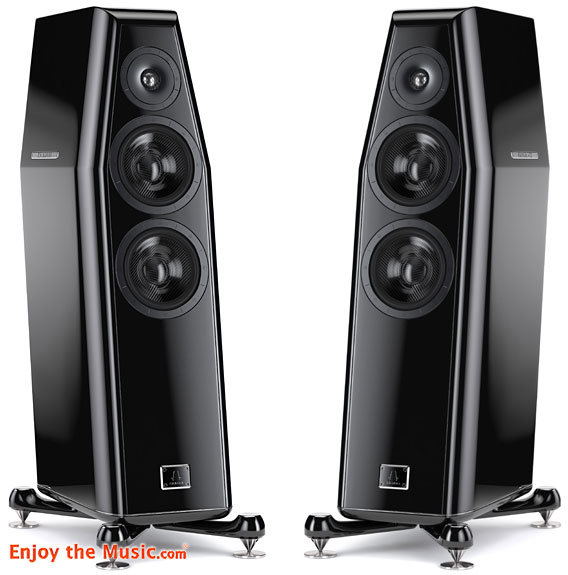
Kharma Elegance dB7-S Floorstanding Speakers
Gorgeous looks… and they look as good as they sound.
Review By Tom Lyle
Let’s be
clear. Kharma Elegance dB7-S are not the largest or the most expensive high-end
loudspeakers one can buy. They aren’t even the largest or most expensive
speakers in the line that they are a part of. But they are gorgeous high-end
speakers that sound as good as they look, and obviously designed, built, and are
intended to be included in the best high-end audio systems that are owned by
those that consider themselves to be discriminating audiophiles. One can place
them into an existing system, or one can build a fine system around these
speakers. Although, in both cases one must keep in mind that if one were to
anthropomorphize these speakers it could be said of them that they do not suffer
fools. In other words, these speakers will reveal both the sonic assets and
flaws of upstream equipment more than most any other speaker I can think of
right now.
Kharma Elegance dB7-S
Floorstanders
The Elegance dB7-S comes to us from the Dutch company Kharma
International that manufactures a wide range of high-end audio products,
speakers, electronics, cables, and something they call “projects”, which consist
of everything from complete A/V systems to furniture. The Elegance dB7-S is a
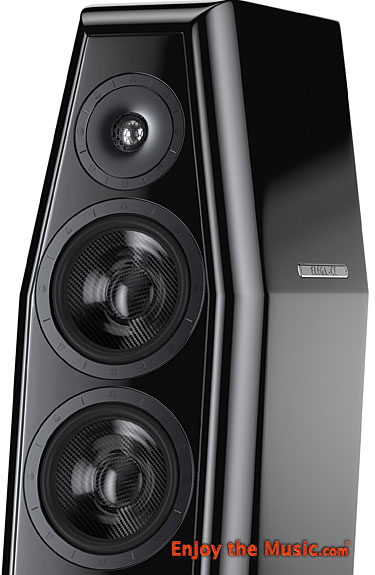
three-driver, floor-standing speaker that rises about 40″ off the ground, that’s
about three and one-third feet, and weighs just short of a very substantial 100
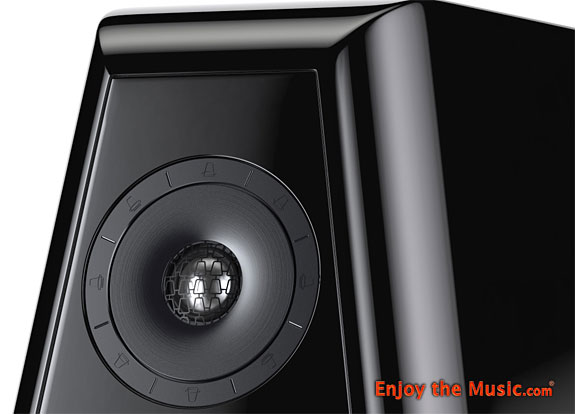
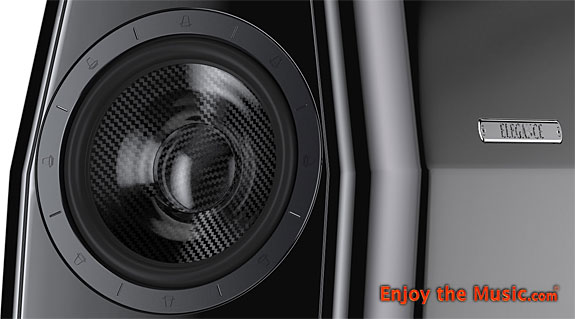
pounds. The pair of seven-inch woofer/mid Omega-7 drivers of the dB7-S are
designed in-house.
A 1″ Beryllium tweeter sits atop of the two larger drivers,
as their advertising hyperbole hits a stride as they describe the speaker’s
behavior as “ultra-high resolution in the midrange depicting the many layers and
sound colors like in excellent wines, where the complexity of the whole history
of making the wine can be tasted in a moment”. These drivers certainly look
impressive, and that’s why I left off the speakers’ magnetically-attached
grilles for the entire length of the review period.
Signature
The “S” in the Kharma Elegance dB7-S denotes that it is a “Signature”
model. Kharma’s Signature models differ from their standard models in a few
areas. First, rather than using composite drivers, the mid/woofers of the dB7-S uses Omega-7 drivers, which have a construction based on Kharma’s “Ultra
High Modulus” carbon fibers, which they claim is “the best fiber available on
the globe today”. The advantage of this material is that it is very stiff due to
the use of a “unique” resin and a proprietary production process that Kharma
uses, which “displaces break-up frequencies of the cone”.
Their Signature models
also feature enhanced damping properties to better absorb energy trapped inside
the speaker’s cabinets, and they also upgrade the internal wiring using a
thicker grade than in the non-Signature models. In addition, the Signature model
uses a vibration-reducing compound on the crossover and on the back plate of the
speaker, which Khama says brings mechanical vibration to an absolute minimum.
Great
After listening to these great looking speakers for a while I
expected that the construction of the cabinets had much to do with their sound,
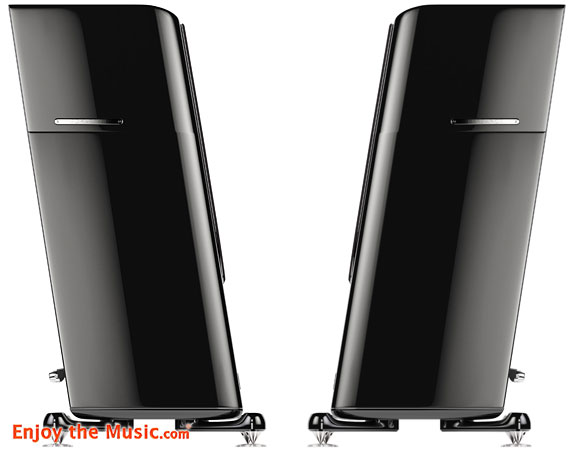
or lack of superfluous sound. In fact, Kharma says that the contour of the
cabinet has lots to do with the sound of the speaker, that “the shape is fully
functional to the way that sound develops from the loudspeakers”. Kharma
improved upon this design from the previous iteration of this speaker, as they
redesigned the stand and the bottom of the speaker’s cabinet, and they
redesigned the front cover as well as made small changes to other design
details.
Interior
In their literature Kharma doesn’t say much about the interior
design of the cabinets of the Elegance dB7-S. When I knocked my knuckles against
the side of the speaker it produced only a “click”. Banging a little harder with
my fist generated a “thud”. These tests, along with my listening sessions led me
to believe that the inside of these speakers is as close to completely inert as
can be. I can think of some other speakers being sold these days that are
designed in this way, but many priced much more than the dB7-S. This cabinet
inflexibility allows the drivers of the dB7-S to be the only thing that moves.
And so, what I was hearing from these speakers was the result of the design
choices of the Kharma engineers, and it obviously led the writers of their
promotional material to scribe the poetic description of the speakers’ sound
above.
System
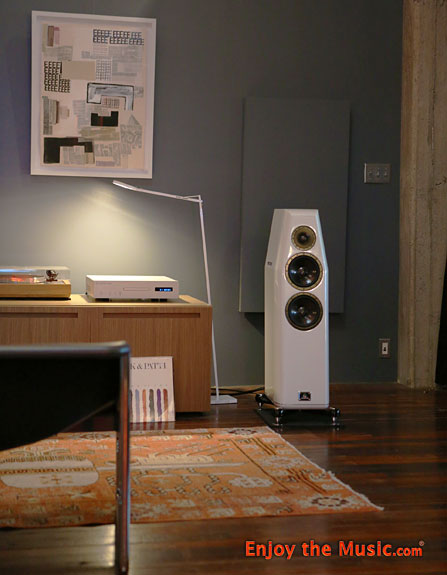
The Kharma Elegance dB7-S speakers were set up in my second
system, located in a common space of our home. The associated equipment during
the speakers’ audition period was generally impressive, and even though I was
limited to the gear I had in-house, I tried my best to select equipment that
would bring out their best qualities. Luckily, the majority of these components
were likely as good, or better than a typical system in which these speakers
would be used. I used both tube and solid-state amplifiers to power the
speakers. A near perfect match for these speakers was a solid-state amp I was
currently reviewing, a 150 Watt per channel Audio Analogue Maestro Anniversary
stereo integrated amplifier made in Italy (REVIEWE D THIS MONTH HERE).
I was
also lucky enough to also have an older favorite on hand, a pair of PrimaLuna
DiaLogue 6 monoblocks, powered by tubes and putting out 70 Watts each. Actually,
the resulting sound surprised me a bit, I thought because they were lower
powered there would be some loss of detail. There wasn’t. They sounded slightly
better than the Audio Analogue amp, and therefore spent most of the time
powering the speakers.
The preamplifier for this system was the Mark Levinson
No 523, not only because it sounded great, but because of its excellent internal
phono preamplifier. Initially I used the M2Tech Nash phono preamp with its
matching Van Der Graaf power supply. But it had to be sent back to the
manufacturer half-way through the Kharma’s review, and so in the interim I used
the Mark Levinson’s phono stage, which performed admirably.
At first analog was provided by a Pro-Ject Debut Carbon Esprit
SB (DC), the turntable’s Ortofon 2M Red moving magnet (MM) phono cartridge
connected at first to the M2Tech Nash phono stage with Van Der Graaf power
supply, and then to the internal phono stage of the Mark Levinson preamplifier.
During the second half of the review the Pro-Ject Esprit SB was replaced by the
much more refined performance of the Pro-Ject X2 turntable with carbon/aluminum
sandwich tonearm, 2″ acrylic platter and much thicker plinth. To match the more
refined performance of this turntable, the phono cartridge was upgraded to a
Sumiko Moonbeam Moving Magnet (MM) cartridge.
And just to make sure I was getting the best out of this
front-end, the phono preamp was also upgraded at this time, so this turntable’s
cable was connected to my reference Pass Laboratories XP-17 phono preamplifier,
and that signal was sent to Mark Levinson preamp. And not only because by this
time in the review period the Kharma Elegance dB7-S had proved that they
deserved the best front-end equipment I could gather together (and because I’m
rarely satisfied), I then switched out the Sumiko phono cartridge and carefully
aligned a Lyra Kleos low-output moving coil (MC) cartridge on the Pro-Ject XS’s
tonearm, adjusting the Pass Labs phono preamps loading settings accordingly.
Explaining which equipment, I used as the front-end for
digital might not be as involved, it was certainly more than sufficient to
provide an excellent musical signal to audition the dB7-Ss. Central to this was
the Benchmark Media DAC3HGC digital-to-analog converter, which uses an
ESS
Technologies ES9028PRO converter chip for not only an extremely low
noise level, but a very musical and powerful sound. When spinning 5″ silver
discs such as CDs and audio DVDs, I used an OPPO BDP-83 Blu-Ray/universal disc
player, which I connected to the Benchmark DAC3HGC via a 75-Ohm coaxial cable.
When playing SACDs I connected the OPPO’s analog outputs directly to a pair of
inputs on the Mark Levinson preamplifier. More often than not when listening to
a digital signal I streamed music from my NAS hard-drives located 2 floors above
this system using a Logitech Squeezebox Touch with is digital output connected
to another of the Benchmark’s digital coax inputs.
Hear
I realize that the above laundry-list of associated equipment
might not mean much to some. To others this information will be very pertinent.
The Kharma Elegance dB7-S speakers deserve the best associated equipment because
they can “hear” everything upstream. Never has the adage “everything matters”
been so true. Not surprisingly, Kharma sent their own speaker cables to be used
with the dB7-S speakers.
Kharma uses a combination of silver and Nano-Carbon conductors
(SNC) to form a hybrid conductor construction for all three of their cable
collections. By using these combinations along with the cable’s construction and
even the effect of air insulation, they design their cables specifically with
their own equipment in mind. The sonic difference between the three collections
is in the amount of precious metal that is they use in its construction, the
purity of those materials, the amount of shielding, and the proprietary
tempering and treatments that they apply to the conductors. Kharma says that
they guarantee that these differences will “be very audible in the appropriate
system”. I believe them.
My listening tests revealed that these are the not only very
sensitive to the associated equipment, but to the recordings that I played
through them. I’ve often said that good equipment helps me hear what the
intentions of the musicians, engineers and producers on each recording. But, can
one really tell what the intentions are of these artists? From personal
experience I can tell you that during the creation of recordings the objective
is usually to get one’s music onto the tape, hard-drive, whatever the medium is,
and not to make any mistakes while doing so. The sonic results are often hit or
miss – a good performance or recording is often the result of dumb luck. I’m
not trying to say that there are not some very talented individuals who have
made recordings that are there for us to enjoy. There are.
But I’d rather not
guess how many of the recordings in my large collection are made by those with
the talent and experience where they expect their recording to sound a certain
way before they start. There are only so many Tony Viscontis, George Martins,
Richard Mohr and Lewis Laytons, Teo Maceros, and Rudy Van Gelders to go around.
The rest are simply musicians and their associates doing their best to get a
record released.
And so, the Kharma Elegance dB7-S let me hear the genius of
the above producers and engineers, and the other half, too, that made these
recordings with the best intentions, hoping that luck went their way. I also
didn’t audition the Kharmas with only SACDs and audiophile approved records,
because the majority of my collection and the music I listen to isn’t audiophile
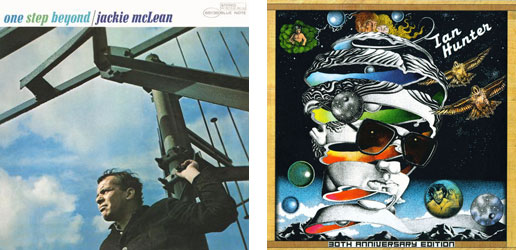
approved. Take, for example, Ian Hunter 30th anniversary edition recording of
his solo LP that he released in 1975, I’m sure you’d recognize the cover of this
LP or CD. I played the plain vanilla CD through the Elegance dB7-Sd more than a
few times during their stay in my system.
This is a great recording. Ian Hunter didn’t hire a “big time”
producer to lead this recording, it is self-produced along with his friend,
guitarist Mick Ronson. It was Ian and Mick who also play the majority of the
instruments, with of course Ian Hunter handling all the lead vocals. Whether or
not it was “dumb luck” or not, this is a massive sounding recording, at least
when played through the Elegance dB7-S. The dB7-S demonstrated that there was no
need for a sub, as the bass was usable down to 30 Hz, and maybe even a bit
lower, since the fundamentals of this bass shook my innards during the many rock
climaxes.
I would never consider Ian Hunter a great singer, although his
distinctive voice has graced not only the many Mott The Hoople records in my
collection, but also his solo work during and after his band’s career. During
the track “Boy” on this self-titled album, it took no effort at all to imagine
him in the vocal booth of the recording studio, the dB7-S rendering a crystal
clear, very lifelike rendition of his “reach out and touch” vocals. All the
instruments on this multi-track recording occupied very distinct areas of a huge
soundstage, even the overdubbed strings were separated from the rest of
instruments and vocals, which formed a silky-smooth backdrop for the rest of the
recording. Ian Hunter’s 12-string guitar sounded larger than life, but still, it
was as if I could “see” behind it, as it formed a 3-D hologram of sound.
“Boy” starts off softly, with
phase-shifted electric guitar beneath his vocals and backing instruments. It
quickly turns to a typical Ian Hunter ballad, with the backing strings entering
at the end of each line. Dennis Elliot, the drummer for Foreigner, of all bands,
forms a rock-solid beat behind it all for a track that I never thought I’d be
talking about in audiophile terms.
I would play all my favorite records and digital files through
the Kharma Elegance dB7-S, and although I can’t say it was “like I never heard
them before”, it certainly brought to light not only many “hidden” sounds, but
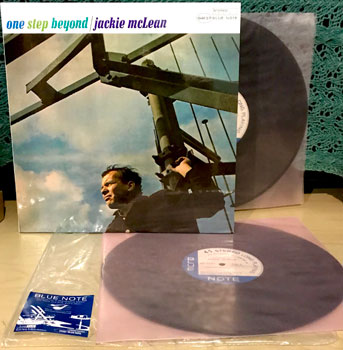
hidden meanings behind the works I listened to. I played Jackie McLean’s One
Step Beyond album on Blue Note Records, both from my two-LP 45 rpm Music
Matters pressing and from the 24-bit 192k digital file. The album was recorded
in 1963 by Rudy Van Gelder in his New Jersey studio, and even though I might be
exaggerating and using oft used phrases a bit here for effect, but when
listening to the album I felt as if I was there in the studio’s control room
with them, listening to a live-mic feed. I could picture in my mind’s ear the
band in the same room, perhaps separated by some sort of baffles, but each of
the musicians being about to see each other as they played.
As is the norm on these Blue Notes recorded by Van Gelder, the
recordings are more like pure two-channel than stereo, as instruments are panned
hard to one speaker or the other. But this didn’t negate the fact that I could
easily hear the studio’s ambience, that is, the sound of the room, or the air
that surrounded each instrument. I didn’t hear this happening with Bobby
Hutchinson’s vibes, but I definitely heard it happen with Jackie McLean’s tenor
sax, where I could even sense whether or not he was sometimes slightly further
away from his microphone than others. It was the same with Grachan
Moncur III’s trombone, who I could picture standing in front of his
microphone, bobbing his head up and down to the music. Again, I might be
exaggerating a bit, but I think I could also smell cigarette smoke.
But to me, the star of the show on this album is drummer Tony
Williams, who one this session might have been all of 19 years old. As I played
either the LP, or the digital file, I could still notice how the Kharma Elegance
dB7-S could “hear” how the drums were set up, and via the speakers’
drawn-to-scale soundstage let me imagine him interpreting what he heard, and
turn it into one of the most engaging jazz recordings in my collection. The
Elegance dB7-S was able to take from the front-end and the associated equipment’s
retrieval of macro- and microdynamic cues, extremely lifelike frequency
extremes, and unwavering midrange transparency and translate all of this into a
lifelike sonic diorama of a drum-kit being played by an extremely talented
musician. My oft times used adage of a great high-end audio system becoming a
time machine never rang as true.
Regardless
The takeaway with these speakers, regardless of the hyperbolic
advertising and my hyperbolic description of their audible properties, is that
they look as good as they sound, and they sound unshakable. Literally. They are
weighty both physically and sonically and reproduce music that sounds like
music.
Kharma’s Elegance dB7-S speakers can handle any genre I
played through them and were very good performers whether powered by solid-state
or vacuum tubes. They are also more sensitive than expected. I don’t mean that
in the way they measure – they are of average sensitivity at 88dB/W/m. Which
means that most would say they’d be happy with an amplifier that puts out
anywhere between 150 and 300 Watts per channel, although they performed wonderfully
with my vacuum tube amps that are rated at 70 Watts per channel. But by
sensitive I mean that they are very susceptible to the equipment they are paired
with, and in a good way too!
Kharma’s Elegance dB7-S speakers will feel at home with the
equipment that a well-healed audiophile as they assemble the most perfect system
as they can, while they continue their search for that musical holy grail.