Verseo Audio Blue Train
Source: Uncategorized • Published:
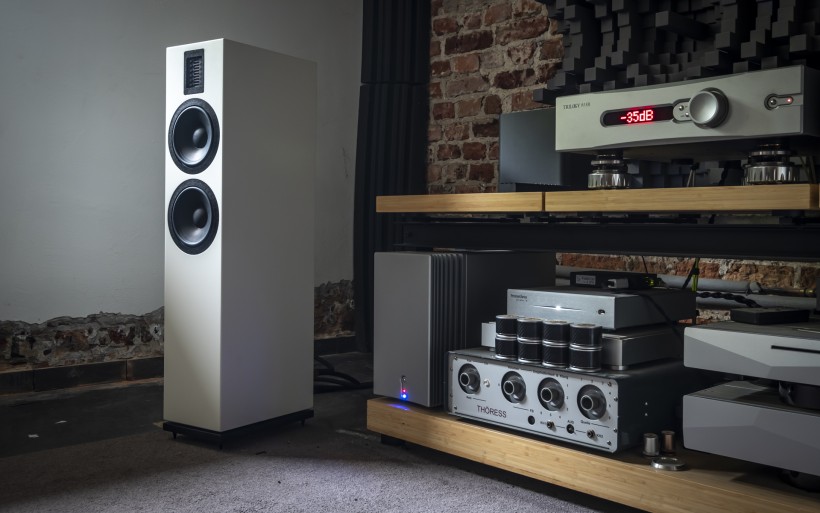
Verseo Audio Blue Train is Marek Kostrzyński’s first commercial loudspeaker under his own banner, so let’s see what happens when a designer with this much experience finally gets to call all the shots. Enjoy!
Embrace the port
Sometimes a review happens because a manufacturer sends you a box. Sometimes it happens because a manufacturer turns up at your door, drops off a pair of loudspeakers, and happens to have rather more hardware in his car than you were expecting. The latter scenario is exactly how today’s story began. Marek Kostrzyński had recently delivered a pair of Qualio Quanteen monitors to me, and somewhere along the way it turned out that these weren’t the only speakers travelling with him that day. There was more stuff in the car, and one particular pair was destined to stay behind. That pair is the reason we’re here now. Meet the Verseo Audio Blue Train. Before we get to the speaker itself, however, it is worth spending a little time on the man behind it. Marek is hardly a newcomer who woke up one morning, decided that loudspeakers looked like fun, and ordered a container of MDF. By the time Verseo appeared, he had already accumulated enough experience to make the usual manufacturer biography look rather inadequate. He spent roughly fifteen years as Pylon Audio’s lead designer, co-founded Cube Audio, helped establish Qualio, designed drivers as well as complete loudspeakers, and worked on dozens of commercial projects for other manufacturers along the way. In other words, if loudspeakers were a university course, Marek has been hanging around the building long enough to know where the interesting laboratories are.
His story started at Pylon Audio, a company he joined when it was still a relatively small Polish operation. Marek became its lead designer and stayed there for roughly fifteen years, working alongside the production side while the company grew into something considerably larger. Pylon eventually became a substantial loudspeaker manufacturer, producing its own designs while also making cabinets and, for some customers, complete loudspeakers for other European brands. That part of Marek’s career is important because it gave him something that boutique loudspeaker designers don’t necessarily acquire by spending years in a workshop with a soldering iron: an understanding of how speakers actually get made, sold and lived with on a commercial scale. He learned the realities of production, cost, compatibility and product positioning, while continuing to develop the thing that interested him most in the first place—the sound. But Pylon was only one part of Marek’s professional life. Alongside his work there, his fascination with full-range loudspeakers resulted in what would become Cube Audio. This was not a quick side project either. The initial Cube development took almost two years, involved dozens of prototypes and required Marek to get his hands dirty with the drivers themselves: magnetic systems, membrane geometries, baskets, suspensions and all the other bits most loudspeaker owners quite reasonably prefer to leave behind the curtain. Cube eventually became known for highly purist full-range loudspeakers built around proprietary drivers, giving Marek a playground where he could pursue ideas that were considerably harder to accommodate in a mainstream product catalogue.
This wasn’t just an academic exercise. Marek had discovered that a good full-range driver could do something that conventional multi-way designs often struggled to reproduce: a particularly coherent, immediate and spatially convincing presentation through the midrange and beyond. He was also attracted to the simplicity of the signal path and the possibility of getting excellent results from relatively low-powered amplifiers. At the same time, he knew very well that full-range loudspeakers come with their own compromises. As wonderfully coherent as they can be, asking one driver to cover practically everything is hardly a free lunch. Marek’s career is interesting precisely because he never seems to have treated one topology as a religion. He likes ideas, then he likes finding out where those ideas break. Qualio was one result of that attitude. This was not an offshoot of the Cube Audio operation, the brand was conceived as a way of bringing some of the qualities associated with Cube’s full-range designs into more versatile and accessible loudspeaker architectures. Instead of relying exclusively on in-house-made full-range drivers, Qualio detoured to components from established manufacturers and explored multi-way solutions without abandoning the things Marek found valuable. The resulting IQ and Quantum models combined conventional enclosed bass sections with dipole arrangements above them, making for a rather unusual and very rare hybrid approach pursued by only a handful of other speaker houses, among them Wolf von Langa. The Quanteen followed the same general thinking in a smaller monitor format, and that was the pair Marek had just delivered when today’s plot took an unexpected turn.
By then, Marek’s professional world had become rather crowded. Pylon was still part of the picture, Cube and Qualio were continuing in parallel, and he was also taking on projects for other manufacturers. Pylon’s design team had also grown, and after years of contributing ideas within different structures, Marek eventually reached the point where the obvious question was what would happen if he simply stopped waiting for a suitable slot to appear in somebody else’s catalogue. He wanted to hoist his own flag and develop speakers where the final call was his. No committee, no need to squeeze a design concept between somebody else’s product priorities, and no obligation to make every design conform to an established house recipe. Just Marek’s ideas, finally given their own address. The answer was Verseo Audio. There is something rather appealing about that trajectory. Pylon had taught Marek trade , and how to turn loudspeaker design into a viable commercial product. Cube allowed him to go deep into the fine arts of driver design from scratch and full-range topology. Qualio gave him room to combine those lessons with more unconventional multi-way architectures. Verseo is what happens when all of that accumulated baggage—some of it useful, some of it painful, and presumably a fair amount of it learned the expensive way—finally becomes his own playground.
That doesn’t mean Verseo is intended to be some kind of anti-Pylon, anti-Cube or anti-Qualio rebellion. Quite the opposite. Marek’s previous work is all over the concept, just not necessarily in the form one might expect. The first Verseo series moves away from Qualio’s open-baffle architecture in favour of conventional enclosures, while introducing several new ideas and being developed in collaboration with Mundorf. Marek has also hinted that future Verseo projects will venture into horns, which shouldn’t surprise anyone familiar with his earlier work. The point isn’t to erase what came before, but to have the freedom to use whatever our man has learned wherever he sees fit. There is also a rather consistent thread running through all of this. Marek has long favoured loudspeakers that are easy to partner with different electronics, designs that don’t force their owners into one narrow system recipe, and aesthetics that can survive longer than the latest fashion cycle. Most importantly, he wants the loudspeaker to disappear as a piece of hardware and leave the listener thinking about music rather than the machinery reproducing it. That sounds obvious enough, until you consider how many loudspeakers spend their entire existence doing precisely the opposite.
And this brings us neatly back to that car. Marek had just delivered the Quanteens, but the Blue Trains were already waiting in the wings. I knew the former well enough to have a fairly good idea of his current thinking, yet the latter represented something different: not another Qualio experiment, not another Cube full-ranger, but its own thing. This time the badge, the brief and the final call belonged to Marek himself. That made the unexpected extra cargo in his car considerably more interesting than it first appeared. Now it was time to find out what exactly he had decided to build when nobody but him was holding the steering wheel. As for how the Blue Train is packaged, I haven’t the faintest idea. Marek arrived with the speakers in his car, each one simply wrapped in foil, so there was no cardboard box to dismantle, and no foam to curse at. What I can tell you is that this is a 2.5-way, passive floorstanding loudspeaker with a bass-reflex enclosure, 4Ω nominal impedance, 89dB sensitivity and a claimed frequency response of 35Hz to 31kHz. Each cabinet measures 92.5cm high, 20cm wide and 32.5cm deep, making Blue Train a rather slim floorstander despite its conventional box-loaded architecture. The standard version costs €5,900 per pair and is available in black or white, with either satin or gloss finishes, while RAL colours and veneers are also offered. The declared impedance and sensitivity also make it a relatively easy load, which is very much in line with Marek’s intention of making Blue Train friendly towards a broad range of amplifiers. On paper, then, this is a compact and approachable floorstander, although the engineering hidden inside its fairly conventional exterior is considerably more involved.
The driver complement is deliberately straightforward: two 6-inch SB Acoustics units with cellulose/paper cones and a Mundorf AMT on top. The arrangement is a 2.5-way design, the upper 6-inch driver handles the midrange and upper bass while the lower one is there primarily to reinforce the bottom end. Put the two six-inch cones together and their effective radiating area is roughly comparable to that of a single 8.5-incher, yet the frontal footprint remains decidedly slim. The upper Satori transducer operates much higher than its lower sibling, while the lower unit is rolled off at around 300Hz with a 12 dB/octave slope. The AMT takes over in the roughly 3–3.5 kHz region, although Marek is understandably reluctant to reduce that transition to one magic number; acoustic crossover behaviour changes with listening angle as the cone’s off-axis output and the tweeter’s dispersion characteristics interact. There is nothing particularly exotic about the topology on paper, but Marek has never been one to treat crossover recipes as sacred. The point is to make the particular drivers behave properly together, not to win a topology-counting competition. The Mundorf AMT is where things get considerably more interesting. Marek didn’t simply take the tweeter out of its box, screw it into the front baffle and call the job finished. Its acoustic surroundings were modified through experimentation with the original Mundorf plate/waveguide, different depths and different shapes, eventually resulting in the saw-tooth-edged damping structure surrounding the AMT. Its job is more ambitious than simply taming reflections. Marek uses it to influence both vertical and horizontal radiation, reduce unwanted radiation from the tweeter and, importantly, alter its overall acoustic behaviour. The aim is to make this monopole AMT behave more like the dipole version used in Qualio, which makes the part particularly relevant when viewed against Marek’s previous work. In other words, one of the ideas behind Blue Train isn’t to reproduce Qualio’s open-baffle construction in another form, but to borrow some of its acoustic behaviour while putting the driver into a conventional enclosure. That’s a subtle distinction, and quite an important one.
The cabinet itself is where the Blue Train starts to depart properly from the usual recipe. Each of the two 6-inch drivers gets its own independently vented chamber , whereas in a more conventional 2.5-way design they would typically share a common enclosure volume. That decision has several consequences. The two drivers are acoustically separated from one another, while each chamber can be tuned in terms of its interaction with its respective driver. Marek also experimented with the internal divider between them rather than simply installing a horizontal shelf or a straightforward diagonal panel. The final solution incorporates a central 45-degree upward angle with shorter horizontal sections towards the front and rear, creating an irregular internal geometry. According to our man, this version proved preferable to a simpler diagonal divider, bringing greater cabinet stiffness and changing the way internal acoustic energy propagates through the enclosure. There was also a small but audible improvement in texture, which is precisely the sort of result that tends to keep loudspeaker designers fiddling with pieces of wood long after everyone else has gone home. The purpose of those irregular chambers goes well beyond making the cabinet mechanically stiffer. Their geometry is intended to control resonances, reduce standing waves and generally tame the acoustic behaviour inside the enclosure. What happens behind a driver doesn’t necessarily stay behind it, after all. Energy generated in the box can bounce around its internal surfaces, return towards the rear of the diaphragm and ultimately modulate what the driver is doing. Marek’s idea is to minimise that stored and reflected energy, so the two drivers can differentiate their respective frequency ranges more cleanly and the midrange doesn’t have to deal with as much unwanted activity from below. The result should be better lower-frequency definition and, ultimately, greater midrange transparency. The internal walls are additionally lined with pyramidal acoustic foam, adding another layer of absorption to the irregular chamber geometry. Mechanical rigidity is part of the equation, but the bigger picture is really about controlling what happens inside the box once the drivers start moving. This is another case where Blue Train’s deliberately conventional exterior hides a considerably more purposeful interior.
The bass-reflex arrangement is another nice example of this philosophy. Because the two drivers occupy separate chambers, each speaker has two bass-reflex ports, one belonging to each enclosure. Both chambers are tuned to the same frequency, but their independence allows Marek to offer something rather more useful than the usual one-port-and-a-plug arrangement. The supplied foam bungs provide four possible configurations: both ports open, both closed, the upper port closed or the lower port closed. Since the chambers are separate, blocking one port doesn’t alter the tuning of the other enclosure. By now the benefit of that should be clear. Had both drivers shared one volume, closing one of two ports would necessarily change the behaviour of the entire system. Here, the two independently adjustable chambers give the owner a surprisingly simple way of tailoring the bass loading to the room and placement. It is a small detail on the specification sheet, but one that makes considerably more sense once the internal architecture is understood. The crossover follows the same pragmatic philosophy. Blue Train uses a second-order network, with the lower 6-incher taking its bow out around 300 Hz and the upper driver continuing towards the AMT. Marek’s position is refreshingly unromantic: there is no universally correct crossover order, no topology that deserves to be carved into stone, and no reason to use complexity for its own sake. Lest we forget, across roughly seventy commercial loudspeaker systems he has used everything from very simple single-element filtering to considerably more elaborate networks, depending on the drivers and the job at hand. In Blue Train, the network uses Mundorf and Jantzen components, while Marek describes the general level of the crossover components and internal wiring as being at the level of the Qualio IQ. The internal hookup wiring itself is copper. At the back, the new winged WBT terminals are particularly easy to operate, proving that even something as mundane as a binding post doesn’t have to be a fiddly affair.
Viewed from the outside, therefore, Blue Train is eminently sensible. It’s a slim, relatively compact floorstander with two modestly sized bass/midrange drivers and an AMT, wrapped in what still looks like a conventional prism. There are hundreds of those on the market, because that’s what most people consider a familiar sight and, consequently, what they want in their homes. The devil, as ever, is in the detail. Marek’s experience accumulated across quite a few brands shows here. Blue Train is exceptionally well made. Fit and finish are up to a very high standard, the paintwork on my pair was flawless, and the cabinets feel solid as a rock. There are also several details that make the design a visual standout. I particularly fancy how the main enclosure connects to its robust base, which is only a hair larger than the cabinet itself, and it also adds to the monolithic appeal of the product. The underside of that base accepts either spikes or the footer of your choice via threaded fittings, which is a very welcome touch. I also appreciate what Marek did around the two 6-inch SB Acoustics drivers. Their baskets, surrounded by neat felt rings that hide the mounting bolts, are the sort of small detail that deserves a shout-out. I genuinely haven’t seen many manufacturers bother with this, even on far pricier loudspeakers. Those bolts have to be there, obviously, but there’s no reason they have to stare back at you for the rest of their lives. Here, Marek simply went the extra mile, and props to him for doing that. With all that out of the way, onto sonics we go. Verseo Audio Blue Train was put to work in my reference system, which currently comprises an Innuos Statement Next-Gen server/streamer, LampizatOr Horizon360 DAC, and a Trilogy 915R/995R pre/power amp analogue end. As per usual with speakers, positioning was the first order of business. Knowing that Blue Train is vented at the rear, I figured it needed some breathing room from the front wall, so I moved each cabinet roughly a metre away from it to start with. That left about the same distance to the side walls as well, while both speakers were toed in so that their axes crossed just ahead of the listening seat, which itself was nearly three metres away. That arrangement already produced nicely controlled bass output, all key images locked neatly into place, and the game was afoot. For the rest of Blue Train’s stay at my place, I didn’t even bother moving them around or experimenting with alternative positioning. They simply worked that way, and they worked really well, so I left well enough alone.
First, I should mention that products like Blue Train, by their looks alone, don’t have me all excited. Regularly shaped and styled vented speakers just don’t do that for me as a reviewer very much into speaker exotics. That said, I didn’t have any enormous expectations about Blue Train’s performance in my room. After all, this affair was clearly built for a mainstream audience. Based simply on what it is, I also had some initial expectations of how it should sound. A ported enclosure makes ported bass, while drivers housed inside regular cabinets aren’t exactly the recipe for dipole sonics. That’s an accurate and perfectly reasonable way of looking at Blue Train, because in many ways this is a conventional speaker. It was therefore only fair to assume that in many regards it would also sound conventional. Then again, this regular looker was made by a guy who’s been in the industry for decades and has quite a substantial portfolio behind him. Blue Train is his own design, so there was clearly more to it than its popular silhouette suggested. I wasn’t expecting it to suddenly defy everything I know about vented loudspeakers, nor did I expect it to magically turn into a widebander, let alone a dipole. Still, considering who made it and how much experience went into the project, I expected there to be something interesting waiting once the music started. So while I didn’t have much hope for Blue Train’s sonics to appeal to my personal taste, I nevertheless expected something to happen. Now I can reveal that something did. Big time.
During one of our conversations, Marek, when asked what kind of sound aesthetic he enjoys privately the most, mentioned that he’s big on vintage drivers with paper cones. And I mean vintage vintage, as in the sort of stuff once used in cinema systems: large paper woofers, high efficiency, old compression drivers and things of that nature. He particularly enjoys the so-called “smoky” vibe that’s built upon a substantial low-end foundation, so a presentation that develops from the bottom up and packs plenty of tone. We could simplify all that by saying that this voicing has some real gravitational pull down low, and that it also works beautifully with old rock and recordings that were never made with modern audiophile hardware in mind. When Marek listens to that kind of fare, he likes consuming it with some of that roughness and grit thrown into the cogs that make it work. In the context of Verseo Audio Blue Train, it came to me rather quickly that this speaker tells you quite a lot about Marek as an audio enthusiast. For the sake of placing Blue Train, let’s invoke two broad voicings. On one side sit many mainstream designs, which tend to be generous with bass because, well, people generally like bass and compact speakers need to make an impression somehow. On the other are those deliberately leaner, more illuminated designs, with a brighter and more open balance that often seems aimed at the more seasoned listener. It is only fair to say that Blue Train firmly belongs to the former camp. This speaker has a lot of reach and presence downstairs, but saying that alone rather undersells how well it performs there. Take Queens of the Stone Age’s “Where the Goth Girls At?”, from the upcoming Perfecth album. The track comes with a dirty, swaggering pulse and those thick, palpable, intentionally heavy guitars, and Blue Train had just the right stuff to make it work. There was proper weight underneath the guitars, but more importantly, that low-end foundation gave the music momentum rather than simply adding bulk. The track moved with a convincing sense of propulsion, the instruments had the necessary physical presence, and the whole thing packed enough tonal density to keep that swagger intact. This was bass doing useful work, in other words, rather than simply announcing its presence.
Just to make one thing clear, Blue Train’s bass still sounded like bass coming from a ported speaker, so it had a particular type of bloom, fullness and voluptuousness to it. There was no pretending otherwise, and although I’m not a big fan of that particular flavour, I nevertheless found myself reaching for one track in that vein after another. The next stop was Eivør’s “Trøllabundin”, a song that serves as one of my measuring sticks as far as bass composure is concerned. To my great surprise, Blue Train handled the intensity of this song, with its deep and persistent low-end presence, extremely well. In fact, it did a far better job here than my sound|kaos Vox3 monitors usually do. The problem with “Trøllabundin” is that, with most ported speakers, I can easily hear the room reacting to the bass when I get up and walk around. I can tell where it becomes more intense and starts to turn overbearing, where it gets sucked away, and where it is roughly right. Those changes naturally correspond with the modes of my listening room. With Blue Train, however, the usual variations were far less pronounced than I’m accustomed to hearing. And let me stress this again: noticeably less so than with the sound|kaos monitors. That genuinely surprised me. More importantly, Blue Train remained impressively composed throughout the track. The bass was present, substantial, and infused with that specific ported flavour, yet it stayed collected instead of spreading around the room and turning into a blur. The usual smear and bloat I hear with this particular recording were considerably reduced, which made the whole thing easier to follow and, frankly, more enjoyable. For a speaker with this much presence downstairs on tap, that level of composure was quite an achievement. This specific trait in isolation already made the Blue Train a major crowd-pleaser. I can easily imagine many potential customers being pleasantly surprised by how well this speaker performs when asked to deal with music built around bass. But composure, all by itself, isn’t quite the whole story. It also made Blue Train remarkably dancey, in a way that serves heavy music particularly well. That Queens of the Stone Age track I mentioned earlier had precisely that combination of drive and downstairs energy because of how Blue Train handled the low end. The output below say 120Hz wasn’t simply there to add weight; it helped push the music forward. And just to be clear, the best results I got in my 21-square-metre listening room came with only one port plugged using the supplied foam bung, unsurprisingly the one for the woofers. Even with that bore blocked, bass output didn’t diminish by all that much. The tonal balance lifted somewhat, as expected, but the momentum and agility remained intact, and on some tracks even elevated. If anything, that combination gave me the best balance between the sheer amount of low-end energy Blue Train can produce and the control needed to keep it moving rather than turning into a sluggish view.
Probably the most surprising thing about Blue Train was that it did all of the above while connected to two monoblocks producing around 50wpc into 8Ω and sporting an almost tube-like output impedance. In other words, these are hardly control freaks. Yet Blue Train worked remarkably well with them. Perhaps I shouldn’t have been quite so surprised, because early on Marek had told me that he deliberately designed his introductory floorstander to present an easy load to an amplifier. He also mentioned that, during audition rounds with potential dealers, at reasonable volume levels Blue Train sounded respectable in small rooms when driven by 15wpc tube decks. Normally, I’d consider such a statement rather bold and, frankly, a little optimistic. After hearing what Blue Train did in my own room with my own Trilogy 995Rs, however, I have to give the man his due. This is an easygoing speaker in the literal sense of the word, and it seems quite happy to work with amps that, on paper, wouldn’t be the obvious partners. Of course, if the idea is to extract even more grip, traction, control and sheer authority from Blue Train, a modern Class D amplifier makes plenty of sense. Such a pairing trades some of the romantic flavour of my valve-like setup for considerably more control and power, and Blue Train becomes even more fearless as a result. To prove the point, I connected it to an Aavik I-588 integrated amplifier, and the improvement in bass grip was immediately obvious. The low end became even more spectacular, without losing the energy and tactility that had made the speaker so enjoyable in the first place. So, yes, Blue Train is easy to drive, but give it a more muscular partner and it will happily show you what that extra control can do.
Moving away from the bass, that above-mentioned smokiness also extends into the midrange. The entire presentation feels gravitational, earthy and dense pretty much across the entire audible bandwidth. I will say, however, that the sound coming from Blue Train never felt veiled, not even once. And that’s worth stressing, because speakers tuned for this level of heft, colour and tonal saturation can easily end up producing an intimate, stuffy, and not particularly open presentation. Blue Train isn’t like that, and here we arrive at its ace up the sleeve: that lovely AMT. Without it, I suspect this speaker could have ended up sounding rather darkish and veiled. The Mundorf tweeter turns that around, opening up the top end and adding plenty of shimmer without breaking the tonal character established lower down. Treble has proper decay, plenty of sparkle and enough energy to significantly enhance ambience and detail retrieval. The AMT also gives Blue Train a rather welcome extra spark elsewhere. Combined with how easy the speaker is to drive, it makes for a surprisingly quick-footed performer. Feed it dynamic music and it keeps up without hesitation, giving the presentation a nimble, elastic quality that prevents all that density and tonal mass from taking over and producing a sluggish, veiled result. That balance is probably one of Blue Train’s cleverest tricks: while earthy, colourful and substantial at its core, it remains open, lively, lucid, and properly palpable. In a way, the AMT doesn’t simply provide the treble; it keeps the entire presentation from becoming too grim for its own good.
Add it all up, and you end up with a floorstander that is very exciting to listen to. Very. I hadn’t seen that coming, and I suspect many people used to such speakers wouldn’t either. While this is a crowd-pleaser clearly aimed at a broad audience, I think it could surprise even seasoned audiophiles who’re rather dogmatic about what they like. Take me, for example. As a fan of widebanders, dipole bass, and ideally the two combined in a single product, I have little interest these days in enjoying a ported speaker. Then again, Blue Train kept me entertained for several very enjoyable weeks. Considering where my own preferences lie, that’s quite telling. Given how well it’s made and how cleverly it is voiced, I couldn’t ask for more. Props to Marek for making a speaker that combines this much sonic character with a dress code to fit comfortably into regular living spaces, not only dedicated audiophile caves. Well done, sir!
Associated equipment:
- Amplifiers: Trilogy 995R, FirstWatt F7, Enleum AMP-23R
- DAC: LampizatOr Horizon360 (Stradi 5U4G + Psvane Summit 4x KT88 / 2x 6SN7)
- Loudspeakers: Boenicke Audio W11 SE+, sound|kaos Vox 3afw
- Transport: Innuos Statement Next-Gen, fidata HFAS1-S10U (on standby)
- Preamplifiers: Trilogy 915R, Thöress DFP
- Speaker cables: Boenicke Audio S3, LessLoss C-MARC
- Headphones: HIFIMAN Susvara Unveiled, Campfire Audio Cascade, Vision Ears VE5
- Loudspeaker signal conditioners: LessLoss Firewall for Loudspeakers, Boenicke ComDev
- Vibration-control accessories: 6x Carbide Base Diamond (under the streamer), 6x Carbide Base Micro Diamond with TwinDamp inserts and spikes (under the DAC and preamplifier), Stack Audio Auva 70 (under the loudspeakers), 12x LessLoss Giant Steps (under the streamer, DAC, and preamplifier), sound|kaos Vibra 68/30 (on standby), Virtual HiFi Vibron M/L/XL (on standby), Stack Audio Auva EQ (on standby)
- Interconnects: LessLoss Entropic Process C-MARC, Boenicke Audio IC3 CG
- Power: Gigawatt PC-3 SE EVO+/LC-3 EVO, LessLoss C-MARC, LessLoss Entropic C-MARC, LessLoss Stellar C-MARC, LessLoss Power Distributor -> Boenicke Audio Power Gate, ISOL-8 Prometheus, LessLoss Firewall 640x Stellar
- USB cable: AudioPhonique Desire USB
- Equipment rack: Franc Audio Accessories Wood Block Rack 1+3
- Network: Fidelizer EtherStream, Linksys WRT160N
- Music: NativeDSD
Retail prices of reviewed components in EU (incl. VAT):
- Verseo Audio black/white in satin or gloss: €5,900/pr